PPG Workshop at IBC 2024

Joel H. Nitta

Outline: PPG Phase II

  • World Ferns
  • Darwin Core (DwC)
  • PPG Editor WFO and Rhakhis
  • Beyond Phase II

PPG Phase II

PPG Phase II

  • We have been working on Phase I (genus level and higher)

  • During Phase II, we will develop the species-level taxonomy

  • We will officially start on Phase II after publishing PPG II at the genus level and higher (ca. Winter 2024)

Decision making process for PPG Phase II

  • No community-wide voting (too many names!)

  • Instead, establish committees for smaller groups (genera, families)

    • Need to consider how regional specialists fit into this model
  • Committees will edit the data directly*

Data for Phase II

  • There are more than 12,000 accepted species and 50,000 synonyms

  • Compiling these data is a huge task!

  • Fortunately, there is an existing database that we can use…

World Ferns

World Ferns (WF)

  • Taxonomic database for ferns and lycophytes maintained by Michael Hassler since 1994
  • 69,231 names total*
    • 13,141 accepted species
    • 816 hybrids
    • 953 accepted infraspecific taxa
    • 54,321 synonyms

https://www.worldplants.de/world-ferns/ferns-and-lycophytes-list

Usage of World Ferns

Taxonomic treatment of WF

  • Mostly follows PPG I (2016)
  • But there have been many changes since
  • Maintained by MH, so all taxonomic decisions are his
  • We hope to ease the burden of maintaining a database of >60,000 names by working as a community

Database format of WF

  • A custom format using Microsoft Word
  • MH has kindly provided us with an exported version of the data (Excel spreadsheet)
  • We (PPG) are allowed to use World Ferns data under the CC BY 4.0 license*
  • I wrote custom R code to convert the World Ferns data to Darwin Core (DwC) format: https://github.com/pteridogroup/ppg-import

Darwin Core (DwC)

What is Darwin Core (DwC)?

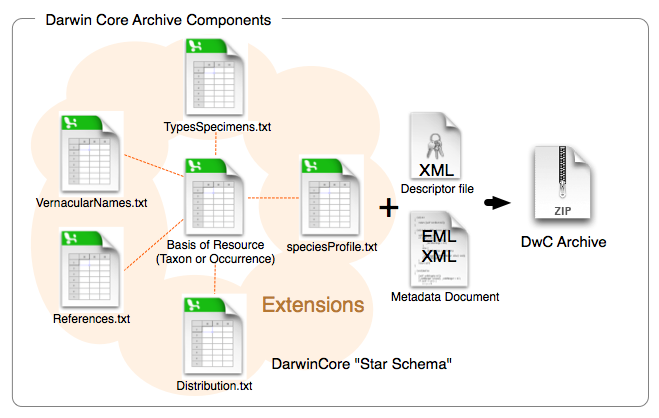
  • A standard for taxonomic data
  • Actually part of a broader standard for biodiversity data (specimens, taxonomy, other collection metadata)
  • More info: https://dwc.tdwg.org/

What is a “standard”?

  • Provides specifications for how to format the data
    • Column names
    • What goes in each column
    • Example: scientificName

https://dwc.tdwg.org/list/#dwc_scientificName

PPG uses DwC

  • The PPG database is a single datatable (a spreadsheet) in CSV (comma-separated values) format that conforms to DwC

Why should we use a standard?

  • Facilitates sharing of data between databases

  • Databases that use DwC

DwC helps us organize data

  • We can have expectations about how the data are organized
    • Synonyms should map to accepted names
    • Lower taxonomic levels should map to higher ones
  • We can validate our data to make sure they meet the expectations (more on that soon…)

An R package to maintain and validate DwC

  • I developed the dwctaxon R package to help maintain and validate DwC

  • Handling taxonomic changes is not straightforward, especially when synonyms are involved
https://docs.ropensci.org/dwctaxon/

Changing taxonomy is complicated

Old version:

  • Accepted species 1: Cephalomanes crassum
    • Synonym: Trichomanes crassum
  • Accepted species 2: Cephalomanes densinervium
    • Synonym: Trichomanes densinervium

New version (C. crassum → synonym of C. densinervium):

  • Accepted species: Cephalomanes densinervium
    • Synonym 1: Cephalomanes crassum
    • Synonym 2: Trichomanes crassum
    • Synonym 3: Trichomanes densinervium

dwctaxon can account for all synonyms

It is better to detect mistakes early

  • There are many possible mistakes with taxonomic data
    • Misspelled names
    • Incorrect accepted name of a synonym
    • non-standard taxonomic status or rank, etc…

dwctaxon automates validation of taxonomic data

dct_validate(filmies_dirty)
Error: check_taxon_id failed
   taxonID detected with duplicated value
   Bad taxonID: 54126747, 54135528, 54135530, 54135531, 54126748, 54126749

https://docs.ropensci.org/dwctaxon/articles/validation.html

  • I use dwctaxon to help edit the data from World Ferns to implement the changes we’ve voted on so far
  • This is helps us maintain a high-quality taxonomic database with minimal manual intervention

PPG Editor WFO and Rhakhis

PPG II requires a new approach

  • PPG I used Google Sheets
  • This was OK for a small number of names (genus and above)…
  • But PPG II (Phase II, at species level) will include >60,000 names
  • We can’t handle all of these with a single Google Sheet

Solution: a web app for editing names

  • By using a web app, PPG members can simultaneously edit the database while minimizing data entry errors

  • I had been developing a custom web app called ppg-editor

  • But then I realized that the Rhakhis tool of World Flora Online could work just as well (better?) and that it is probably a better option (they have a professional software development staff, I am just doing what I can as a researcher who happens to know some R)

About World Flora Online (WFO)

  • A taxonomic system for all vascular plants and bryophytes

  • Each group maintained by a Taxonomic Expert Network (TEN)

  • PPG is a TEN

https://worldfloraonline.org/

https://about.worldfloraonline.org/tens/pteridophyte-phylogeny-group

PPG and WFO

  • We have not yet provided our data to WFO

  • We plan to submit PPG II data as soon as it is ready (Fall/Winter 2024?)

Rhakhis

  • WFO maintains a webb app to edit taxonomic data in the WFO database called “Rhakhis”

Greek form of rachis, the ‘backbone’ of a leaf or inflorescence

https://list.worldfloraonline.org/rhakhis/ui/index.html

https://list.worldfloraonline.org/rhakhis/ui/index.html

Rhakhis

  • We will use Rhakhis for Phase II (the species-level taxonomy)

Using Rhakhis

  • Anybody can log in using their ORCID ID
    • I can help get you set up with one today if you don’t have it yet
  • In order to edit data, you need to be given permission for a particular group (likely genus or family)
    • We will be setting this up soon

Using Rhakhis

  • There are two versions of Rhakhis
    • The “normal” editor
    • The “sandbox” editor
  • They are identical, except that any changes made in the “sandbox” will be erased overnight (it is for testing only)

Using Rhakhis

  • I can demo using Rhakhis with the Sandbox version

  • You can log in with your ORCID and browse the data, but not edit anything (yet)

  • Check the user manual

Beyond Phase II: Integrating PPG and FTOL

  • Work on a complete, species-level fern tree (FTOL v2) is in early stages
    • current FTOL (v1.6.0): 5,785 species = ca. 50%
  • The ultimate goal is to have a unified, species-level database including the taxonomy and tree

https://fernphy.github.io/

Beyond Phase II: Integrating PPG and FTOL

  • We (organizers of PPG and GoFLAG) are planning a similar project to GoFLAG to complete FTOL
    • Taxonomic experts can submit tissue samples and have priority access to resulting data
    • We hope that collaboration with all PPG members will result in a complete FTOL!

Discussion